The Fairplayer Story
The Fairplayer Story by Carles Barrobés
2025-07: A musician and a software engineer walk into a bar…
This could be the beginning of a joke, but it’s kind of the origin story of Fairplayer (@fairplayer). Every collective story is a collection of interweaved personal stories, and this is mine.
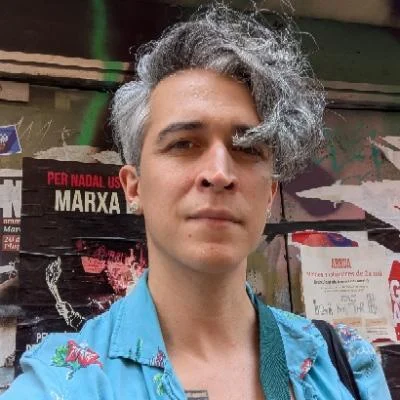
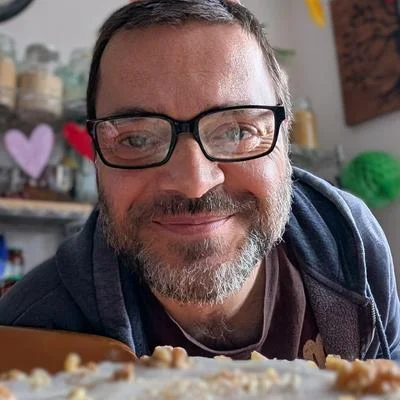
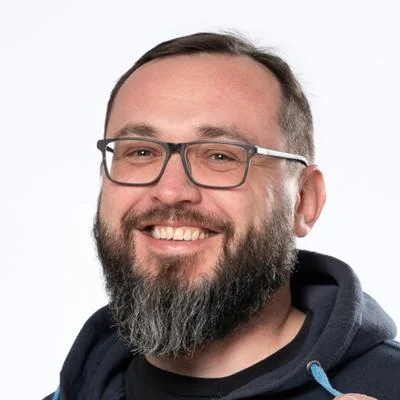
The musician is Guillem (@blankfosk) and the developer is me, Carles (@txels). The scene is the Guinardó neighbourhood in Barcelona, Catalunya. The conversation focuses on an upcoming boycott to “the streaming platform that must not be named”, boycott that is gathering momentum. Musicians from the local scene are seriously enraged, and want out. Quickly. The genocide in Palestine is on everyone’s minds.
Out of the “S” platform, but where to? We talk about what alternatives are there that won’t end up becoming the same type of extractive enshittified platform. Because we are dreamers from the world of free software and mutual aid, we know there can be alternatives. Guillem is part of a creative collective (anartist.org) that is already on Funkwhale… but he feels Funkwhale is not particularly usable, from the point of view of the listener’s user experience. He suggests exploring creating a “Funkwhale theme” focused on simplicity. I suggest “what about a player that is just a client for the Funkwhale API?”.
After that chat we get all pumped. Guillem starts creating some designs in Penpot. He is on fire. I guess he’s not sleeping much from excitement and working on this. I tell him I am going on vacation, we’ll catch up in September.
2025-09: Let’s get started
Back from vacation, recharged and ready to start. We iterate on the concept of decentralisation. We decide that the platform should not be tied to Funkwhale alone, rather a more universal “play music from a decentralised ecosystem” – multiple music “catalogs” that are indexed by a player that acts as a “hub”. We build a simplistic proof of concept catalog (just to have some initial way to upload music), and we start working on the player.
We don’t have a name yet. We think we are facilitating an “Exodus” from one platform, so we name those first components the “Exocatalog” and “Exoplayer”. (I’m really glad we didn’t stick with that name. We shouldn’t define ourselves by what we are against, rather what we are for.)
Mid-September we start talking about this cool tool that musicians use to set up their websites called Faircamp. A friend of Guillem’s (Marcel) has helped him set one up for his small indy label – Radi Solar. We think Faircamp is a great candidate for a decentralised catalog component, and we feel we can offer added value to Faircamp users.
By this time we think the concept of decentralised catalogs could include our own catalog, Faircamp, Funkwhale, and potentially Mirlo and Bandwagon. We are quickly learning about all the exciting things going on in the independent digital music ecosystem – it’s buzzing with activity.
…meanwhile, in a parallel space
While I’m working on tech, Guillem, Marcel and other friends at Anartist have been discussing the intersection of politics and music. How to organise and transform the ecosystem beyond a tool. These concerns had been macerating for a while within @anartist.
2025-10: We have a name
It feels like we made a good decision going for Faircamp as a starting point. It has a community of users that really love the tool and believe in self-hosting their music. And Simon Repp (@freebliss), the Faircamp developer, is a fantastic human being.
We start using the name “Fairplayer” (you may at this point realise where we got inspiration from) and manage to register some domains, including fairplayer.band.
In parallel, things are moving (slowly but surely) in the activism space (led by a group we call La instrumental, which has the same two meanings as in English, because we like puns), with the idea of organising as a cooperative. Temptative name “Mistu” (which sounds like the catalan name for “match” as in the small thing that you can strike to make fire).
We know that it could take a long time for the local musicians collective action to get organised, but we can start experimenting with tech in parallel, to show what is possible, to open up scenarios. And organised collective action can be hard, and may eventually fail… so in the worst case, if that mobilisation doesn’t prosper, at least we can leave a legacy that Faircamp users can benefit from.
In the meantime, Guillem the big motivator is getting a bunch of people eager to join Fairplayer. We will make a presentation of what we have done so far and where we think this could go.
2025-11: The team grows
First encounter with new people interested in participating: Sofi, Macià, Juan Diego aka Tlayoyo, Vera, Victor… I may forget some. For the first time I realise this will be nothing like than my previous typical “activist software” experiences, mostly solo or duo endeavours. I panic. The codebase is not ready. I am not ready. But it is the good kind of panic, like when you’re slowly getting to the top of a rollercoaster.
The new people will bring diverse skills and perspectives to Fairplayer: UX, design, community outreach, management/organising skills… Suddenly I’m a part of something bigger, that will soon become part of something even bigger.
2026-02: “First Movement” – the soft local launch
Getting ready for the big reveal. “La instrumental” has organised a full-day session to present the big ideas to a large group of artists, by the name “Primer Moviment” (catalan for “First Movement” – musical puns strike again). There will be a few panels where various cooperatives will talk about their experience, and we’ll demo Fairplayer. The goal is to make it tangible to the artists that we can own our destiny, govern ourselves cooperatively, create our own tools, and not be at the mercy of capitalist monopolies.
The build up has been stressful for us at the product team. Misaligned ambitions and expectations, last minute changes… but we have a working product, where people can self-signup to, and add their Faircamps to the player. The team is tingling with anticipation.
The day unfolds and it feels like a big success. The audience engages, there is a great positive energy in the room. We have opened up the collective imagination, we now have more people who believes it is possible. We are not that crazy after all. Or at least we are not alone in our crazy.
The outcomes: there seems to be enough interest in creating a listeners cooperative, and we think it is possible to do this with our own and existing free software tools.
2026-03 – The Fediverse launch
I had been looking forward to this for quite some weeks, and the day has finally come. The public announcement of Fairplayer to the Fediverse (where a number of Faircamp users seem to hang out), and general availability signup.
Up to now, we had been reaching out to individual Faircamp musicians we thought would be receptive to the idea, and had found a few early adopters, as well as skeptics and non-responders. Among the early adopters the reception had been good, the feedback was encouraging, although they were very few, and I wasn’t sure how representative they could be.
I would like to take this opportunity to give heartfelt thanks to @helenbellmusic @kidlightbulbs and @james@sunny.garden for the email exchanges and chats, and being receptive to a random dude from the interwebs emailing them about “yet another independent music platform”. They were the first people outside of our “inner circle of local artists” to join Fairplayer.
Also thanks to the great efforts of @sofisoft reaching out to local bands and labels and helping them get into Fairplayer via our Faircamp install parties. Sofi is probably responsible for getting half of the current artists in Fairplayer. We love you Sofi.
2026-04 – finally, fairplayer.org
So… in the rush to ship something that people could start using, we knew we had taken some shortcuts. One of those shortcuts was having a site that explained the project… this had been long planned and slowly in the making (due to the perennial lack of hands of volunteer projects), but we launched at last! fairplayer.org is live.
It’s still a work in progress (as these things always are), but it starts to show more of the picture.
And meanwhile Mistu, the listeners cooperative, is in the womb, getting ready to be born, nurtured by a growing group of people. Labour expected sometime after the summer.
Enough origin, what is the destination story?
There is something about the fascination with origin stories, in particular for tech companies (and possibly in the anglosaxon culture), that makes me cringe a bit.
A couple dudes (they are always dudes) in a garage or uni dorm (because they have the privilege to afford either of those) in a first world country (close to finance capital, another privilege) work on something that becomes a world success. Purely based on “their own merits”.
But to me, much more important than the origin story, is the destination story. The fact that those companies with romanticized beginnings ended up as horror movies: monopolistic giants that invade their users’ privacy, exploit the content that users created without rewarding their authors, and invariably follow the enshittification path that every capitalist-funded company ends up trodding: achieve market domination, use that to squeeze as much value as possible out of producers and consumers… we’ve seen that too often.
So, what is the destination story of Fairplayer? What is the future we want to create?
The short term reality: diverge to converge
We’ve come to an interesting point, that we had somehow anticipated. We now have shipped something of value which we call “Fairplayer for Faircamp”, and in the meantime the local “listener’s cooperative” Mistu is starting to take shape.
We know that short term the “Fairplayer for Mistu” and “next steps for Fairplayer.band beyond Faircamp” will have different priorities, so they may eventually be handled as separate projects in the short run, feeding from different needs and desires.
…diverge
What is “Fairplayer for Mistu” aka “local-first” Fairplayer?
- Built with and for the local community,
- It will probably prioritise tools to promote the local scene, bands near you, concerts and other events “in meatspace”, to de-virtualize music
- Much of the outreach and participation will be via local events near Barcelona
What is “Fairplayer in the larger independent digital music ecosystem”, aka “streaming-first” Fairplayer?
- Built as part of a system of like-minded projects (starting with Mirlo)
- Create a communication channel with artists that are contributing to the platform via their Faircamp sites so they can be more involved in the future of Fairplayer
- Focus on interoperability formats and protocols
- Double down on “what does it take to create a resilient decentralised platform”, e.g. by supporting Faircamp owners with monitoring/alerts, finding ways to compensate hosting expenses…
- Most of the outreach will happen in the Fediverse
I imagine these two collectives will have different needs, so we will most likely be running two separate instances, based on the same software although they may have different sets of outward-facing functionality.
…converge
BUT… eventually both efforts should reinfoce each other, and at some point we have a Fairplayer platform that:
- A community of place, purpose or passion can self-host and run
- Allows uniting around a scene, which can be a locality (Barcelona), a genre (reggae), or a shared purpose (creative commons music, archival material for folklore preservation…).
- Each community can decide the rules of governance, compensation, participation…
- You can connect the player to your sources of music (the catalogs) which can be different technologies, running on domains you own (individually or collectively)
- Multiple Fairplayer instances, each run by their community, agree to share content, and have mutual understanding for cross-compensation
The mycellial network of independent music platforms
This is where we come back to where we started, but with a much better knowledge of what’s out there, and some friends we’ve made along the way. When we say we want to facilitate a decentralised music ecosystem, what is it really the role we see ourselves playing among the Faircamps / Mirlos / Funkwhales / Bandwagons and other song creatures of the digital?
First and foremost I would love for Fairplayer to be the glue, the mycellium, the connective tissue that makes it possible that various systems work together, even those that were designed to work in isolation like Faircamp.
Because Fairplayer is a hub, an index, that wants to learn how to talk to different platforms, and wants to define the protocols that make that possible. It can thus become the missing integration point across diverse projects. Those projects may not have the capacity to talk to each other, but if Fairplayer can read and Fairplayer can (re)share those contents, and provide some compensation layer, then even a simple self-managed static website can become a piece in a large music ecosystem that one can be proud to be a part of.
A resilient ecosystem that no capitalist can buy.
A summary of our values
As we start putting our values in writing, this is our working draft summary of what we stand for:
- Collective ownership beats client-provider relationships: participatory, constructive, optimistic.
- People centric beats tech-centric.
- Cooperation beats competition: free software, free and universal culture.
- Inclusivity beats uniformity: simple, diverse and for all audiences.
- Community beats individualism: mutual aid, attentive to already existing (local) collectives.
- Decentralisation beats centralisation: a federated, local blueprint that can be universally replicated.
- Sustainability beats accelerationism: inspired by degrowth, rooted in slow rhythms and emotions.